The first full day of a few days in Weymouth turned out to be a bit damp. Some light rain in the morning gave way to dryer periods but it did not stop me walking along the front to Lodmoor RSPB reserve. A good variety of ducks and waders were present along with one or two Marsh Harriers hunting over the reedbeds.
One of the birds I was hoping to see was the Lesser Yellowlegs that had been present since 5th October. However there was no sign to this American vagrant on any of the shallow pools on the south and western sides of the reserve when I arrived. There were however 25+ Snipe, 20+ Black-tailed Godwits, 20+ Dunlin, 2 Ruff, Lapwings and a Redshank. Wildfowl included Shelduck, Gadwall, Wigeon, Shoveler and Teal. Water Rails and Cetti's Warblers could be heard in several areas. Several species of Gulls were present, most notably 7 Mediterranean Gulls.
One of 7 adult Mediterranean Gulls present.
One of the Black-tailed Godwits, most of which were asleep.
A rather smart Lapwing
This Kingfisher was conveniently perched close to the pathway.
Ruff - One of two present.
Two of the Dunlin feeding alog the waters edge.
A size comparison between a Dunlin and two Black-tailed Godwits.
A very confiding Robin was just asking for it's photo to be taken!
The rest of the photos are of the star bird, a Lesser Yellowlegs.
The bird was originally out of view in one of the middle pools but was eventually
flushed by a Marsh Harrier and landed fairly close to the footpath.
I have seen quite a few Lesser Yellowlegs on the far side of the Atlantic
but this was only the second I have seen in the UK,
October and November will go down in history as being the largest invasion of Hawfinches ever recorded in the UK. The birds are thought to have originated from central Europe where their food supply of Hornbeam and other seeds have failed.
I had recently been to Steps Hill (24th October) and was fortunate to see 8 Hawfinches fly over. This was however small beer compared to the 90+ seen on one or two days. So with my daughter Katherine visiting for half term, we both decided to try and get to Steps Hill close to dawn. We actually arrived at 6:45am and found Dick Seekins in position but he had drawn a blank up until then. We stayed with Dick for some time and eventually heard one fly overhead but come not see it. We also had one or two Brambling in flight. Dick left and we were joined by Francis Buckle but we did not manage any further sightings in what was a fairly foggy morning.
Katherine and I moved on to College Lake for an hour or so and picked up most of the common ducks including Shoveler, Wigeon, Teal, Gadwall, Pochard, Tufted Duck, etc. Overhead we had a few Redpoll and in the distance a Linnet and Yellowhammer. We eventually decided to try for Hawfinch again but this time at Great Hampden where Warren Claydon had seen 24 feeding the previous day.
It was about a 20 minute drive to Great Hampden and we walked past the impressive "Great Hampden House" and into a Kale field where a footpath conveniently crossed it. A few small group had been left in the field and it was in one of these that Warren had seen the birds the day before. Before we had got the the first group (a copse of mainly Oak) Katherine caught sight of one or two Hawfinches feeding in a group of trees that was further away and one landed on a tall tree in the copse in front of us. We eventually moved through the copse to emerge on the footpath on the far side and got good scope views of the Hornbeam where the birds were feeding. We scanned the whole tree and counted about 7. Then a group of 16 birds flew across our field of view, followed a short while on a group of 6 and then 11. Then the original 7 birds flew out of the tree but there were in fact 9, making a total 42 Hawfinches.
A amazing result and many thanks to Warren for putting out details on where the birds were feeding the previous day. Later that afternoon John Edwards and Graham Smith managed to see 36 in the same area.
Hard to see Hawfinch as it was feeding on the Hornbeam tree.
Tis Hawfinch fly out from the Hornbeam and perched in full view for a while but rather distantly.
The grid ref for this site is SP843025. Good luck if you try in the next few days.
After Dave Cleal and Adam Bassett had combined to discover two Dartford Warblers at Stoke Common two days ago, I was fairly keen to see them in case their stay was a short one. My daughter Katherine, who is staying with us over half term, was also keen to see one, as they don't occur in her current county of residence (Lancashire). So off we went to Stoke Common with two grandchildren in tow. Not the best combination for finding a skulking bird!
Several birders had tried to find them and found it difficult, but having been given directions on the last known locations from Dave Ferguson and Graham Smith we were soon in the right area in roughly the middle of the common. I had heard from Adam that they were associating with two Stonechats, so when we located the Stonechats we started to scan for the Dartfords. We were fortunate to hear a call from a Dartford and a couple of notes of song. A while later we caught a glimpse of a male Dartford as is flew low over some thick vegetation in order to keep up with a Stonechat. Then almost immediately we saw another bird which turned out to be a female. This bird stayed fairly close for some time but was in thick vegetation and almost impossible to see let alone photograph. I eventually managed record shots of both birds.
We eventually gave up as the youngest member of or group was getting impatient and moved to the western end of the common to where what was potentially a third bird had been heard. We were very fortunate in that we saw a Dartford in flight crossing the path we were on. It perched some distance away allowing me to digiscope it. It seems to a be a juvenile bird. That of course raises the question of possible breeding here. However it is late in the season and it is my belief that this bird was probably raised elsewhere and came here as part of normal post-breeding dispersal.
We can only hope they stay here for the long term as it was 2003 that they were last known to have bred here.
A very distant view of one of the Stonechats. These were surprisingly elusive.
Dartford Warbler - male. Well Hidden!
Female
Female leaving the same bush as above and showing proximity to a Stonechat.
What is pretty much an annual event for me is a trip to Gibraltar Point in Lincolnshire for a weekends birding with members of the Bucks Bird Club and also with my daughter Katherine. So thirteen of us attended this year, staying in the Crown Hotel, which is a short drive from the reserve.
Some of the group met at Frampton Marsh on route to Gibraltar Point and enjoyed a mornings birding. Highlights were Little Stint (c8), Curlew Sandpiper (c6), Ruff, Spotted Redshank (1), Dunlin, Avocet, Scaup (1), Wigeon (1000s!), Whooper Swan (2), Marsh harrier and good views of Brent Geese. By mid-afternoon Dave Ferguson, Katherine and myself decided to move on to Gibraltar Point NNR.
We arrived late afternoon and wandered up to the Wash Viewpoint. Nothing of note to see until a Marsh Harrier flew overhead. It was getting dark and a short while later Katherine spotted a Barn Owl on it's way to hunt. It was soon joined by another and we watched them until it was almost dark. A great start to the weekend.
Early Saturday morning five of us (Dave Ferguson, Andrew Noel, Hester Plumridge, Katherine and myself) decided to go out before breakfast and visit Mill Hill to see what birds were moving and to see the high tide wader roost. It did not disappoint! However the sea watch was disappointing.
Knot at Sunrise
Clouds of Knot and other waders making their way to the high tide roost.
Knot performing over the high tide roost
A short video of Knot on the beach and also in flight.
After breakfast we explored the rest of the reserve, taking in the freshwater marshes and the "Plantation". High winds made birding on the beach/dunes a bit of a challenge!
A Curlew attempting to eat a Crab! Unusual diet item?
Success after several attempts.
A brief video of the Curlew
Snipe - Seen from the hide at Tennyson Sands
Avocet - Seen from the hide at Tennyson Sands
Kestrel - A very tame bird seen apparently looking for worms on the ground
Spotted Redshanks - Very busy feeding on the freshwater marshes.
Whooper Swans - About 20 birds flew low over the hide at Jackson Marsh on the Sunday morning.
We got lunch in the cafe on the reserve. A great asset to the reserve and very popular.
Lunchtime - Jim, Katherine, Dave and Andrew
Sunday was a similar routine, although we did get closer to the wader roost which was amazing! Birding was difficult in fairly strong winds but we were alerted of the presence of three Ring Ouzels by Chris Young and we made our way to where they had been seen. Katherine was on her own when she found a female which eluded the rest of us. However Hester and myself had the briefest of views of a male as it flew across the pool near the Pines car park.
All in all an enjoyable weekend with some good birds seen, even though there were no real rarities around (that we could find!).
It has been a while since I twitched a rare bird, so when a Rock Thrush turned up in South Wales, I teamed up with Dave Parmenter and Dave Cleal to see it. The bird was in it's fifth day since being discovered by an 80+ year old birder high in the mountains at Pwll-Du. It was a pleasant walk with great views across the valleys. The weather was a bit breezy but with some pleasant sunshine.
It was a straightforwards journey and we arrived on site about 11:00am. We walked about a mile along a mountain top track, passing a steady stream of birders leaving the site, all looking happy having seen the bird. Once we arrived we soon saw the bird perched higher up on the rocks and managed a few photos. Over the next hour of so the bird moved around a fair bit, dropping down to the level we were on. Never really close but good enough to get reasonable photos.
There are 36 prior records of this species in the UK.
The bird was initially found and photographed by photographer Adrian Roche on Friday 6th but news did not break until that evening after Adrian contacted Mike Wallen. The bird could not be found on Saturday 7th in poor weather conditions. Then early on the morning of 8th, Dave Bilcock relocated the bird, put the news out and this allowed a good number of birders to see the bird throughout the day.
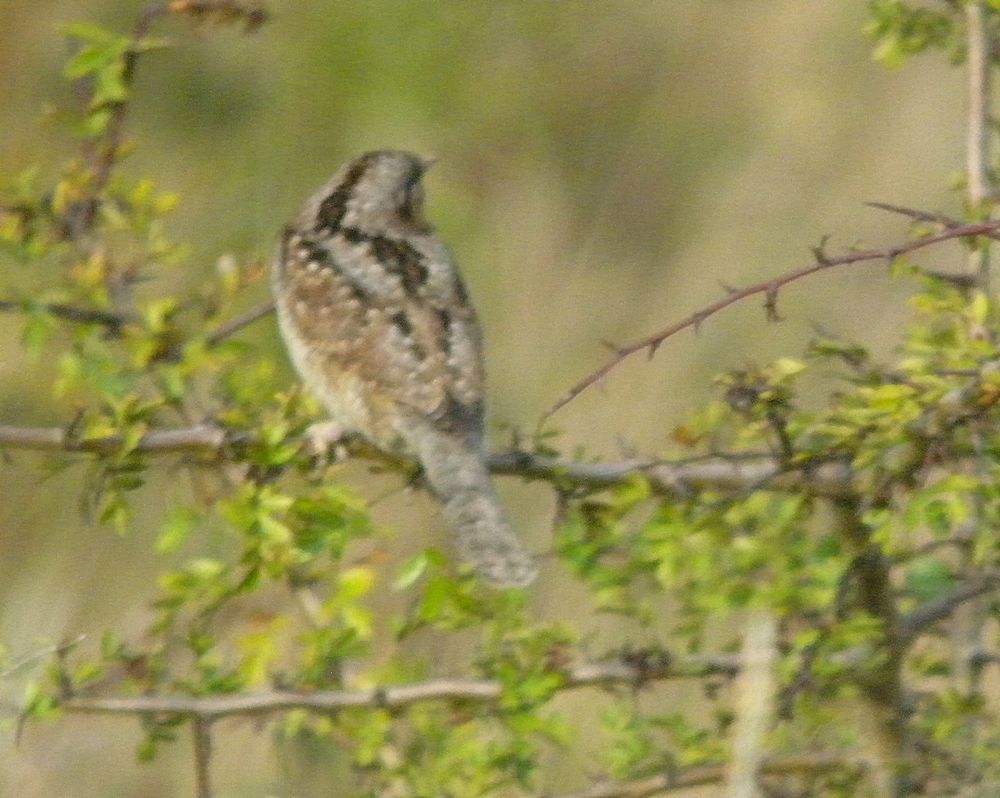
I was busy Sunday morning so could not get over to Pitstone Hill until after 4pm. Several birders were on site, including Mike and Rose Collard, Dave Parmenter, Robert Norris and Paul Moon. The bird did not show for about an hour but eventually flew to some nearby stems and eventually it moved along the line of bushes along the fence. I managed a few photos before deciding to leave it in peace and go home to watch the second half of the England match (That was not a great idea!). This was the fifth Wryneck I have been fortunate enough to see in the county.
The first photo I took was not that sharp (rather rushing to get a shot!) but it at least shows the dark plumage down the centre of it's back.
The only half decent photos I managed to get was when it perched on this post for a a minute or so.